
The Portuguese Festa: Blood, Dust, and Honor
The dust rose before the bulls ever entered the ring.
By late afternoon, the little farming towns of California’s San Joaquin Valley had already begun to gather beneath strings of colored flags and the smell of linguiça smoke, sweet bread, and trampled earth. Portuguese families came in pressed shirts and dark hats, women carrying babies on their hips while old men argued loudly in Azorean Portuguese beneath the shade of flatbed trucks. In places like Turlock, Gustine, Hilmar, and Tracy, the annual Festa was more than a celebration. It was a memory. Homeland. Survival.
And when the band music faded, and the gates finally opened, the bullfight began.
The Portuguese-style bullfights brought to California in the early twentieth century were different from the Spanish corridas most Americans imagined. The bulls were not killed in the arena. Instead, the spectacle centered on bravery, horsemanship, and precision — a dangerous dance between man, animal, and pride. Portuguese immigrants from the Azores carried the tradition into the valley alongside their dairies, vineyards, and Catholic festas, where it became woven deeply into community life.
The most admired figure in the ring was often the cavaleiro, the mounted horseman dressed in old-world costume atop a beautifully trained Lusitano horse. His task was to guide the charging bull with impossible calm, leaning low from the saddle to place bandarilhas into a padded section on the animal’s back. The crowd watched as much for the horse as the rider, because a nervous mount could mean disaster in seconds.
Working beside him were the bandarilheiros, quick-footed assistants armed mostly with courage and a cape. Their duty was distraction. They drew the bull’s attention away from the horseman when danger closed too quickly, stepping into harm’s way with startling grace.
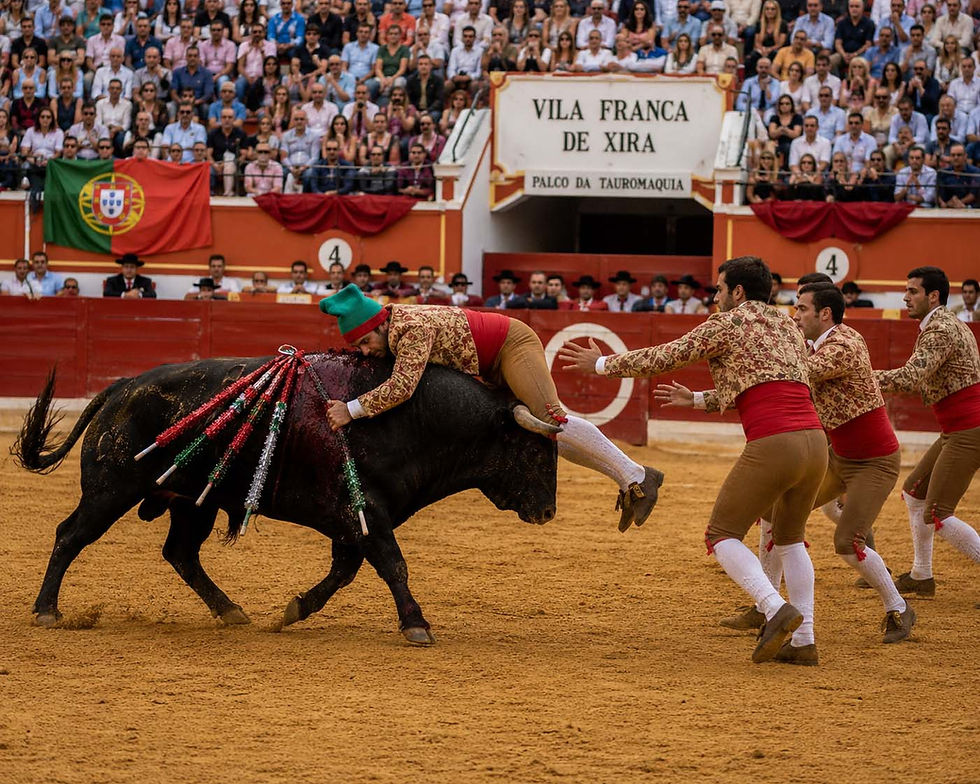
But the loudest cheers usually belonged to the forcados. Eight men. No weapons. No protection.
They stood shoulder to shoulder in the dirt while the crowd leaned forward in uneasy silence. The lead forcado — the forcado da cara — would call the bull toward him, waiting until the last possible moment before throwing himself at its head, gripping horns and neck while the others rushed in behind to wrestle the animal to a stop with their bare hands. Broken ribs and concussions were common. Sometimes worse. Yet young Portuguese men throughout the valley considered it an honor to stand in that ring.
In the 1930s, during the hard years of drought and Depression, these festas became even more important across the San Joaquin Valley. Families who struggled through failed crops, labor shortages, and grinding poverty still gathered for the Holy Ghost celebrations and bullfights because the traditions reminded them who they were. For one afternoon, the music played, the dust swirled gold in the evening light, and the old country lived again beneath the California sun.


Comments